
XERF vs. Ultherapy PRIME: Which Skin Tightening Treatment Is Right for You?

Executive Summary
XERF and Ultherapy PRIME are two of the most advanced non-surgical skin tightening technologies available today. While both stimulate collagen production and improve skin laxity, they use fundamentally different energy sources and target tissue in different ways. Understanding these differences can help determine which treatment is best suited to your goals.
Key Takeaways
✔ XERF uses volumetric radiofrequency (RF) energy.
✔ Ultherapy PRIME uses microfocused ultrasound.
✔ Both stimulate collagen but target tissue differently.
✔ XERF excels in dermal tightening and skin quality.
✔ Ultherapy PRIME is ideal for SMAS lifting.
✔ Many patients benefit from combining both technologies.
Introduction
Skin laxity does not develop in a single layer. With age, collagen and elastin gradually decline, while the connective structures that support the face become less resilient. The result may include softer facial contours, early jowling, reduced jawline definition, and laxity of the neck.
XERF and Ultherapy PRIME are both non-surgical treatments designed to stimulate tissue remodeling, but they do so in fundamentally different ways. XERF uses multifrequency monopolar radiofrequency to create controlled, volumetric heating across selected tissue depths. Ultherapy PRIME uses microfocused ultrasound with real-time visualization to create precise thermal coagulation points at predetermined depths.
Because the two technologies differ in energy source, heating pattern, treatment depth, and clinical emphasis, the most appropriate option depends on the patient’s anatomy, degree of laxity, skin quality, treatment goals, and tolerance for treatment sensation.
Why Skin Becomes Loose
Facial aging is a multilayer process. Changes occur in the skin, subcutaneous tissue, retaining ligaments, fat compartments, and deeper fibromuscular support structures.
Within the dermis, collagen fibers become fewer, thinner, and less organized over time. Elastin quality also declines, reducing the skin’s ability to return to its original position after movement or stretching. At deeper levels, weakening connective support and shifts in facial volume may contribute to jowling, neck laxity, and loss of jawline definition.
For this reason, not every patient benefits from the same energy-based treatment. Some patients primarily need broad dermal remodeling and improvement in skin firmness, while others require more focused treatment of deeper structural layers.
Dermal Aging
Dermal aging is associated with progressive changes in collagen, elastin, hydration, and extracellular matrix organization. Treatments that create controlled bulk heating within the dermis may support gradual remodeling and improvement in overall firmness and skin quality.
Deeper Structural Laxity
When laxity involves deeper connective and fibromuscular layers, a treatment capable of placing energy at discrete, predetermined depths may be more appropriate. This distinction is one of the central differences between radiofrequency-based tightening and microfocused ultrasound lifting.
How XERF Works
XERF is a non-invasive multifrequency monopolar radiofrequency system. It combines 6.78 MHz and 2 MHz frequencies to deliver controlled RF energy across shallow, middle, and deeper treatment settings.
Radiofrequency does not depend on a specific pigment target. Instead, electrical energy encounters resistance within tissue and is converted into heat. This controlled thermal response is intended to produce soft-tissue coagulation and initiate progressive collagen remodeling.
Unlike a treatment that creates isolated focal points, XERF is designed to generate broader volumetric heating. Its three depth settings and multiple intensity levels allow the provider to adapt treatment according to tissue thickness, treatment area, and the patient’s skin profile.
Multifrequency Monopolar RF
The 6.78 MHz and 2 MHz frequencies are used to shape energy delivery across different tissue depths. This allows the provider to select a treatment approach based on whether the goal is more superficial tightening, intermediate remodeling, or deeper structural heating.
Real-Time Impedance Feedback
XERF analyzes tissue impedance during treatment. Because tissue characteristics vary between patients and treatment areas, impedance feedback helps the system adapt energy delivery to the individual skin profile.
Surface Cooling and Patient Comfort
Integrated Cryogen Delivery cools the skin surface during treatment, while Wave Fit pulse technology helps control the pattern of energy delivery. These features are designed to protect the epidermal surface and improve treatment comfort without routine topical numbing.

How Ultherapy PRIME Works
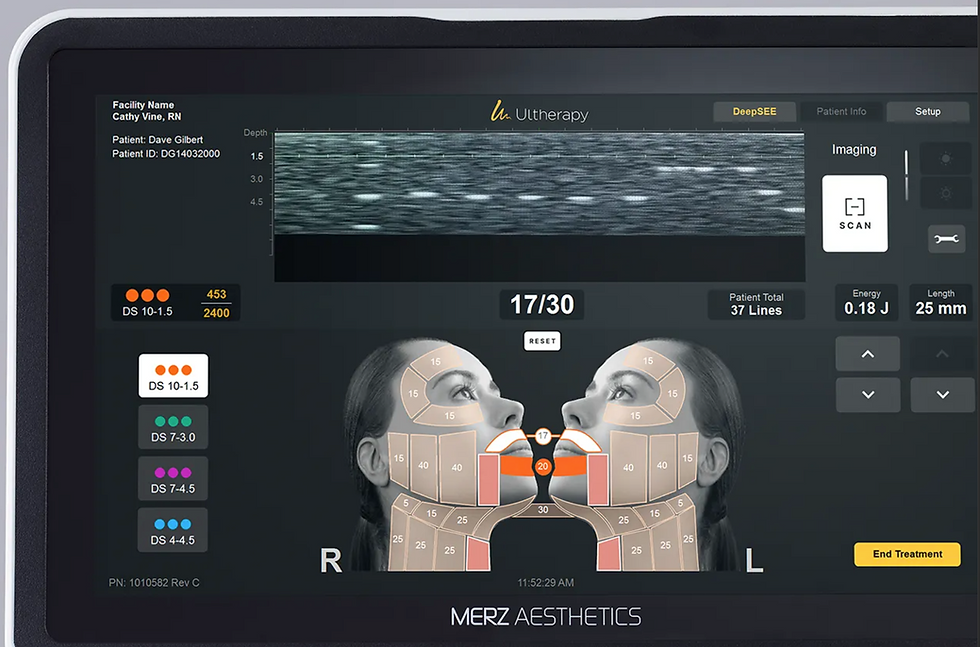
Ultherapy PRIME uses microfocused ultrasound with real-time visualization. The treatment delivers acoustic energy into small, precisely positioned focal zones beneath the skin while allowing the provider to view the treatment anatomy on screen.
Where the ultrasound energy converges, it produces discrete thermal coagulation points. These controlled treatment zones initiate collagen denaturation followed by a gradual regenerative and remodeling response.
Ultherapy PRIME transducers are designed to treat at 1.5 mm, 3.0 mm, and 4.5 mm depths. These correspond broadly to the superficial dermis, deeper dermis, and deeper fibromuscular layers such as the SMAS or platysma, depending on the treatment area and individual anatomy.
Microfocused Ultrasound
Rather than heating a broad volume of tissue, Ultherapy PRIME concentrates ultrasound energy into a series of small focal points. Tissue between these points is largely untreated, while each focal zone receives a controlled thermal stimulus.
Real-Time Visualization
The DeepSEE visualization system allows the provider to evaluate tissue layers, confirm transducer contact, and position treatment lines at the intended depth. This imaging component is a defining feature of the Ultherapy platform.
Treatment at Multiple Depths
The 1.5 mm transducer targets superficial dermal tissue, the 3.0 mm transducer targets deeper dermal tissue, and the 4.5 mm transducer reaches deeper fibromuscular support layers. The selected depths and number of treatment lines should be individualized rather than applied identically to every patient.
Key Differences Between XERF and Ultherapy PRIME
XERF and Ultherapy PRIME should not be viewed as interchangeable versions of the same treatment. They differ in energy source, distribution pattern, imaging capability, target depth, and the type of tissue response they are designed to create.
XERF emphasizes broad, controlled radiofrequency heating across selected tissue depths. Ultherapy PRIME emphasizes precise point-by-point treatment at defined depths with real-time ultrasound visualization.
Feature | XERF | Ultherapy PRIME |
Energy Source | Multifrequency Monopolar RF | Microfocused Ultrasound |
Primary Mechanism | Volumetric tissue heating | Focused thermal coagulation points |
Target Tissue | Dermis & connective tissue | Dermis + SMAS |
Treatment Depth | Adjustable depth modes | 1.5 / 3.0 / 4.5 mm transducers |
Real-Time Imaging | No | Yes (DeepSEE Visualization) |
Ideal For | Skin tightening & skin quality | Lifting & structural support |
Downtime | Minimal | Minimal |
Best Candidates | Mild–moderate laxity, skin texture improvement | Mild–moderate lifting, lower face, neck, brow |
Who May Benefit Most from XERF?
XERF may be considered for patients whose primary concerns include mild to moderate skin laxity, reduced firmness, early jowling, softened facial contours, or declining overall skin quality.
It may also appeal to patients who prefer a treatment based on broad radiofrequency heating, minimal interruption to normal activities, and progressive rather than surgical correction.
Mild to moderate facial or neck laxity
Early loss of jawline definition
Reduced skin firmness or elasticity
Preference for broad dermal and connective-tissue remodeling
Preference for a treatment that generally does not require topical numbing
Who May Benefit Most from Ultherapy PRIME?
Ultherapy PRIME may be considered when the treatment goal includes precise energy placement at deeper structural levels, particularly in areas such as the lower face, submental region, neck, or brow.
It may be especially relevant for patients who have relatively preserved surface skin quality but show early structural descent or weakening of deeper support.
Early brow, lower-face, or neck laxity
Loss of definition beneath the chin
Need for treatment at precise anatomical depths
Preference for treatment guided by real-time ultrasound visualization
Interest in deeper structural collagen stimulation
Can XERF and Ultherapy PRIME Be Combined?
In selected patients, the two technologies may be complementary. Ultherapy PRIME can be used to address specific dermal and deeper fibromuscular layers, while XERF can provide broader radiofrequency remodeling across the dermis and connective tissue.
Combination treatment is not automatically necessary for every patient. The order, timing, energy level, and treatment areas should be determined after evaluating facial anatomy, skin thickness, volume distribution, prior procedures, and individual goals.
Frequently Asked Questions
Which treatment is better, XERF or Ultherapy PRIME?
Neither treatment is universally better. XERF is designed for broad multifrequency radiofrequency heating, while Ultherapy PRIME delivers focused ultrasound at precise depths with real-time visualization. The better choice depends on the depth and pattern of laxity, skin quality, anatomy, and treatment goals.
Which treatment reaches deeper tissue?
Ultherapy PRIME provides defined treatment depths of 1.5 mm, 3.0 mm, and 4.5 mm. XERF uses selectable depth modes and multifrequency monopolar RF to create broader heating across shallow, intermediate, and deeper tissue zones. Because the technologies distribute energy differently, depth alone does not determine which treatment is more appropriate.
Is there downtime after treatment?
Both treatments are generally associated with minimal interruption to normal activities. Temporary redness, swelling, tenderness, tingling, or sensitivity may occur depending on the treatment area and individual response.
When will I see results?
Some patients notice early changes, but collagen remodeling develops gradually. Visible improvement is typically assessed over the following weeks and months rather than immediately after treatment.
Can I receive both treatments?
Yes, selected patients may benefit from a combination plan because the treatments use different energy modalities and tissue patterns. A provider should determine whether combination treatment is appropriate and how the sessions should be sequenced.
Which Treatment Is Right for You?
The most appropriate treatment cannot be determined by age or device popularity alone. Skin thickness, facial structure, degree of laxity, volume distribution, previous procedures, and personal goals should all be evaluated before selecting XERF, Ultherapy PRIME, or a customized combination plan.
Schedule a personalized consultation at WooYoo Medical Aesthetics in Koreatown, Los Angeles.
At WooYoo Medical Aesthetics, every treatment plan is customized after a detailed facial assessment rather than recommending a single device for every patient.
Schedule your consultation today to determine whether XERF, Ultherapy PRIME, or a combination approach is best suited for your goals.

Comments